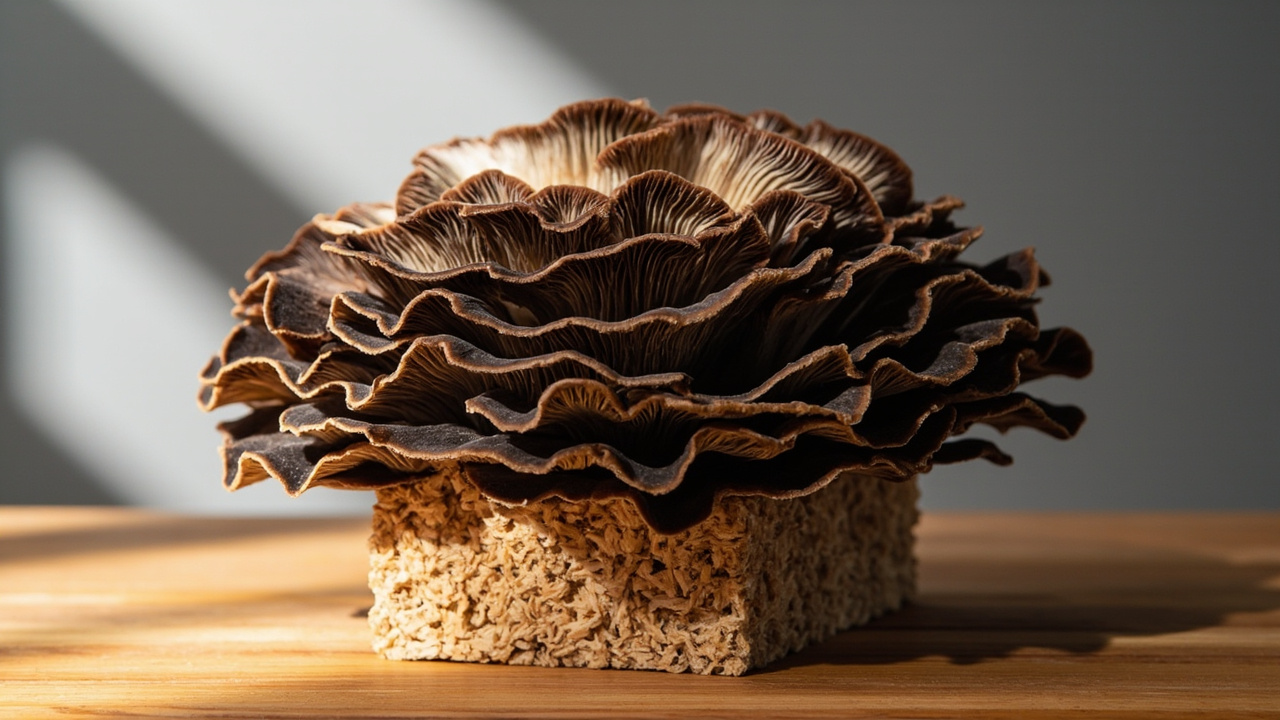
Maitake is the next chapter after your first oyster or lion’s mane flush — not the first kitchen project. It is more temperamental, wants a cooler room, and runs on a longer timeline, but the flavor and the dramatic fronded rosette are worth the patience if you go in with eyes open.
Quick answer
Grow maitake on a supplemented sawdust block for the fast route (pins in roughly 2-4 weeks) or on hardwood logs for the patient route (first fruiting in 6-12 months). Cooler rooms (55-65°F) and steady humidity at the cut face (70-85%) are the two non-negotiables. Start with oyster or lion’s mane first if you have never fruited a kit before.
What this is / is not
What this is
This is a kitchen-friendly, gourmet-only guide to Grifola frondosa — also called hen of the woods, ram’s head, or maitake. We cover block cultivation and log cultivation for the home grower who wants a culinary harvest on a real timeline.
What this is not
This is not a supplement or capsule guide. We do not make medicinal claims, and we do not cover extracted powders, tinctures, or therapeutic dosing. It is also not a beginner’s first project — see oyster or lion’s mane for the easier on-ramp.
Decision tree
Branch A — Have you grown a gourmet kit before?
- Yes (one clean oyster or lion’s mane harvest) → continue reading.
- No, this is my first gourmet project → start with oyster first; come back to maitake after one clean flush.
Branch B — Pick a starting form
- A supplemented sawdust block (faster, more predictable, smaller commitment) → Path A.
- Log plug spawn (longer wait, larger yields once established, more weather-dependent) → Path B.
- Liquid culture or grain spawn (intermediate; for after you’ve done a block) → see grow-bags.
Branch C — Are your kitchen conditions in the species range?
- 55-65°F at the cut face, 70-85% humidity → block route works.
- Warmer or drier → wait for cooler months, or set up a humidity tent.
Branch D — How patient is your timeline?
- Harvest this season → Path A (block).
- Comfortable waiting 6-12 months → Path B (logs).
Why grow maitake (culinary only)
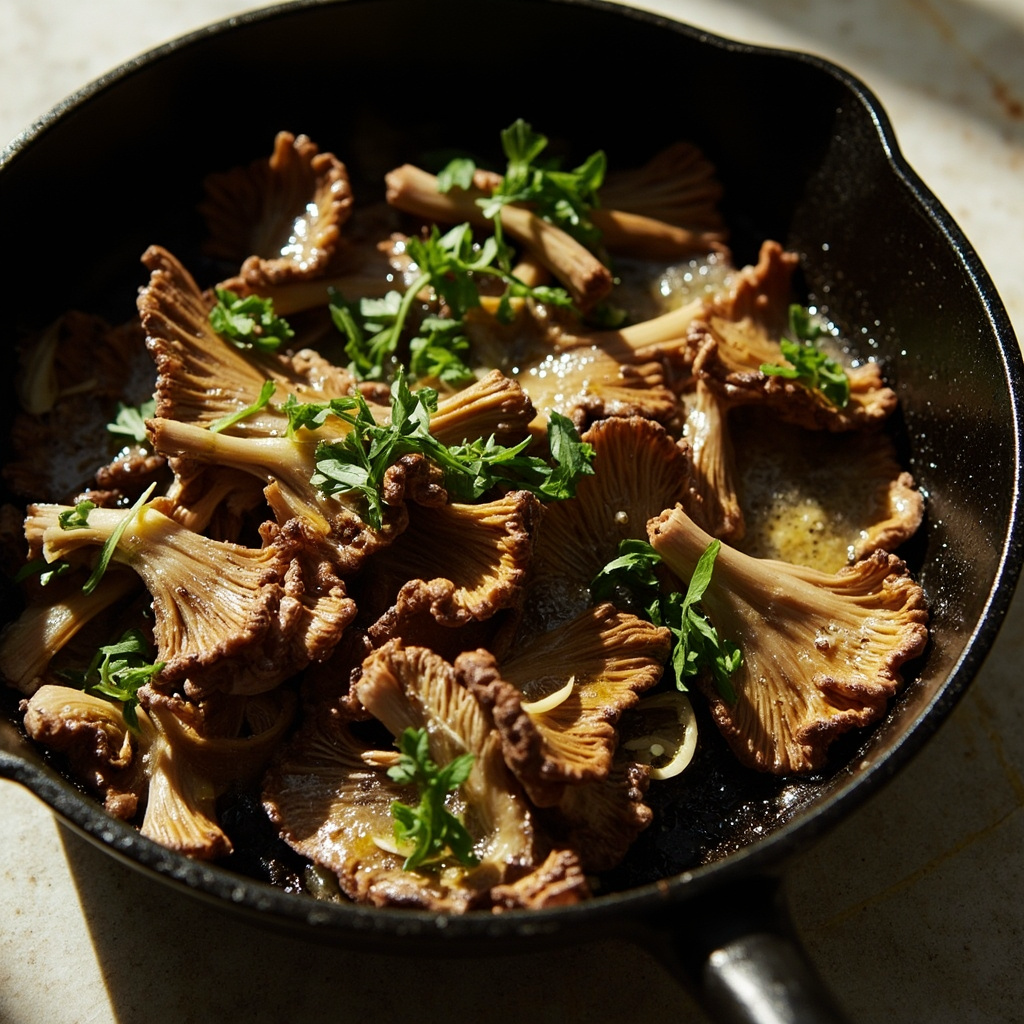
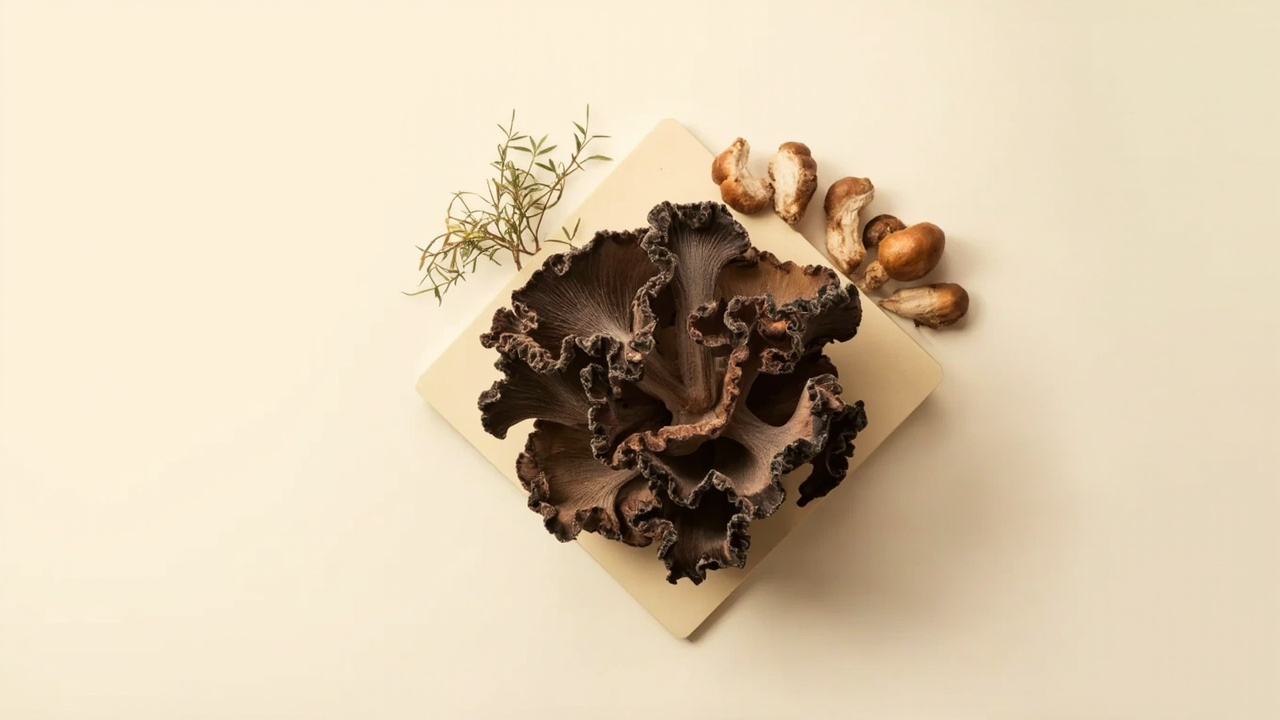
Maitake is a culinary mushroom first: rich, earthy, slightly peppery, with a tender frond texture that holds up to high-heat cooking. The classic preparation is the whole rosette seared in butter with garlic and parsley, but it splits into individual fronds for stir-fries, pasta, and roasted vegetable medleys. We focus on growing and cooking it here — not on supplements, nootropics, or extracted powders.
You can also slice and dry the fronds for soups and risottos. Most kitchen growers harvest a fresh rosette, cook half that night, and dry the rest for later in the week. A fully dried frond keeps 6-12 months in an airtight jar and rehydrates in warm water in about 20 minutes. The dried flavor is even more concentrated than fresh — the dehydrator concentrates the umami and the peppery edge into something that punches into a stock or a cream sauce.
Is this right for you?
Maitake is the right next step if you have at least one clean oyster or lion’s mane harvest, a room that stays roughly 55-65°F through the pinning window, and the patience to wait 8-16 weeks from block to first flush (or 6-12 months on logs). Skip maitake if you have never fruited a kit, your kitchen is consistently above 70°F, or you want a harvest inside two weeks.
If you want a strong indoor flavor mushroom that also runs slower than oyster, look at shiitake — it has similar patience demands but is more forgiving on a basic kitchen block.
Path A: From a grow block (default)
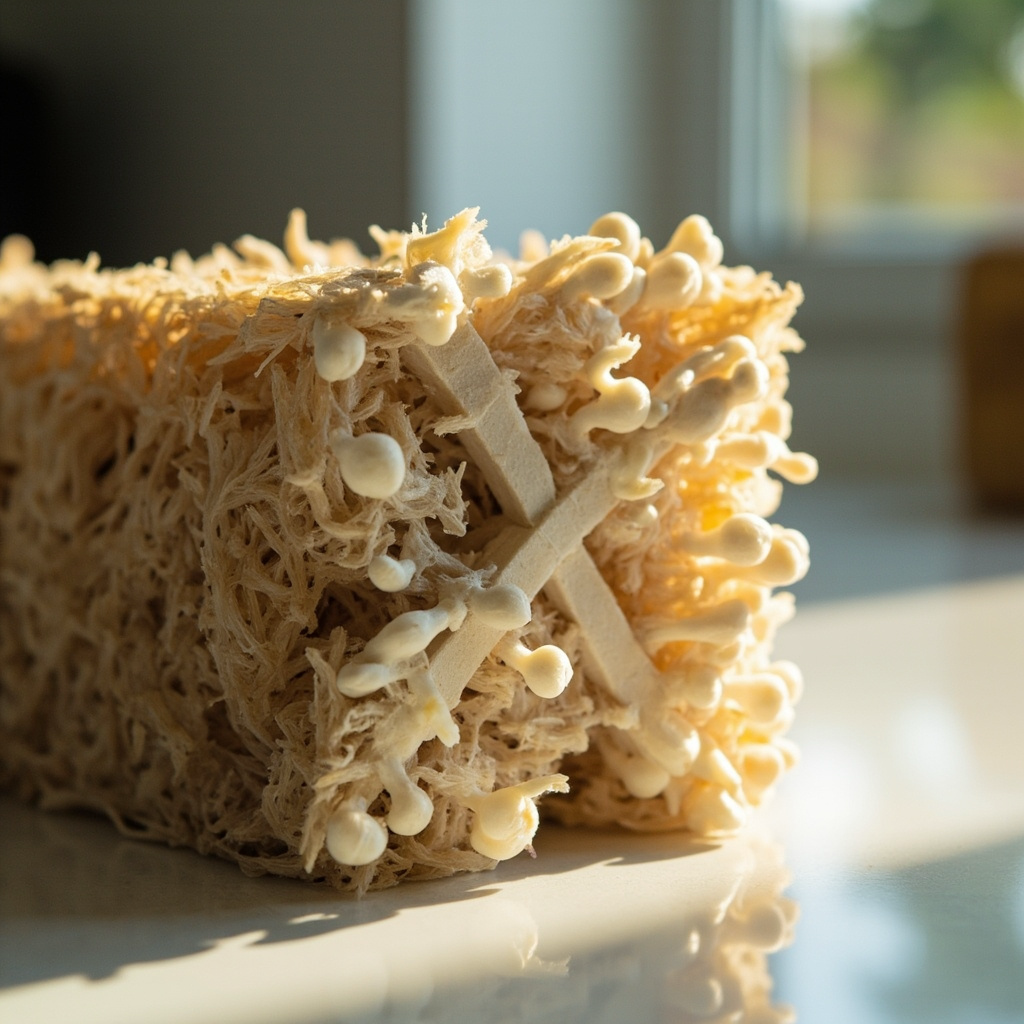
The block route is the kitchen grower’s quickest path to a maitake rosette. Manage it like a fussy oyster block, with three adjustments.
Cut. Make a wider X than you would for oyster — roughly 3-4 inches across, instead of a 1-inch nick. Maitake clusters are large and need room to push out without tearing the surface.
Cool. Aim for 55-65°F at the cut face. Above 70°F, maitake often aborts pins or produces thin, abortive clusters. A cooler room, a basement corner, or a temperature-controlled fruiting tent helps.
Mist. Mist gently, twice a day on the cut face, with a fine-mist spray bottle like the Plaode 3-pack continuous mister. Dew, not puddles. If droplets run down the bag, you are over-misting.
A multi-species all-in-one grow bag like the Shroomability Wood Mushroom All in One takes the prep step out: it is pre-sterilized supplemented sawdust, comes in a 5 lb / 2-bag format, and is sold for oyster, lion’s mane, turkey tail, maitake, and reishi in one bag — useful when you want to try two species on the same equipment.
If your kitchen is very dry in winter, a 4-tier fruiting tent with LED and timer gives you a stable microclimate without rebuilding your kitchen. Optional, not required.
Path B: Logs / next level
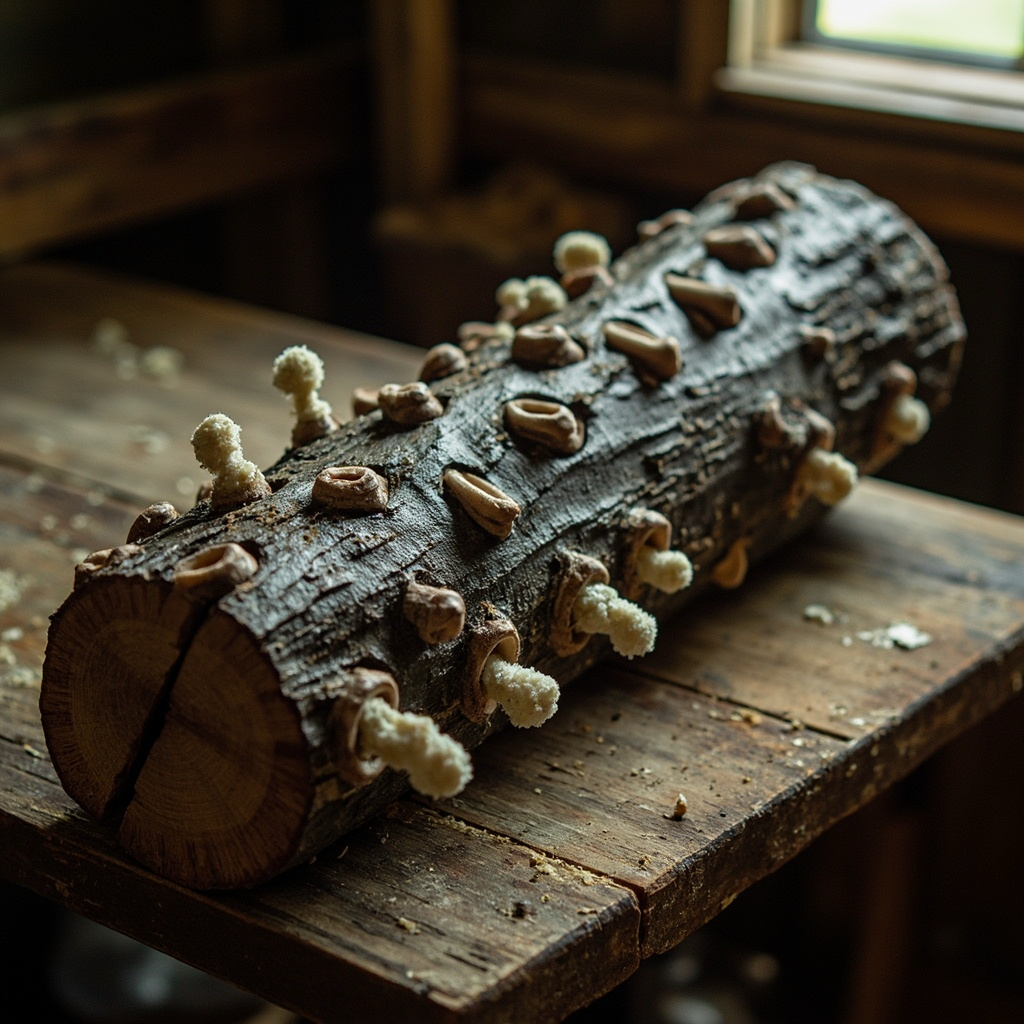
Log cultivation is the long-form play for maitake. It mirrors shiitake log cultivation more closely than block cultivation, and it rewards patience with larger flushes once the log is fully colonized.
Source. A fresh-cut hardwood log — oak, maple, or beech — 4-8 inches in diameter, 3-4 feet long. Cut in late winter or early spring when the tree is dormant; age the log 2-4 weeks before inoculation. Avoid softwood (pine, spruce, cedar) — the resins inhibit mycelium and you’ll be waiting forever for a flush that never comes.
Inoculate. Drill rows of holes roughly 6 inches apart along the log, 1 inch deep. Hammer in Liquid Fungi maitake plug spawn (100 plugs covers a 3-4 foot log easily), then seal each hole with melted cheese wax or beeswax to keep moisture in and contamination out. A small camp stove or a cheap fondue pot works for melting the wax — no need for fancy equipment.
Incubate. Stack the logs in a shaded, well-ventilated spot — under a tree canopy, against a north-facing shed wall. Keep them off the ground (a pallet or two cinder blocks works). Don’t expect quick results: the mycelium needs 6-12 months to fully colonize the wood before the first fruiting. During that time, ignore the log. Watering is only needed in extended dry spells.
Fruit. Maitake logs fruit in late summer or early fall when nights cool. The rosette often emerges from the same spot for years — a single log can produce 3-5 seasons of flushes if you keep it moist and shaded. The first flush is usually modest; the second-year and third-year flushes are when logs really pay off.
Conditions table
| Variable | Range |
|---|---|
| Temperature | 55-65°F (cut face) |
| Humidity | 70-85% at the cut face |
| Light | Low ambient — indirect daylight, no direct sun |
| Air | Gentle, non-direct — a still room is fine; a sealed bag is too still |
| Colonization | 8-16 weeks for a sawdust block |
| Fruiting | 2-3 weeks after pins emerge |
Harvest & second flush
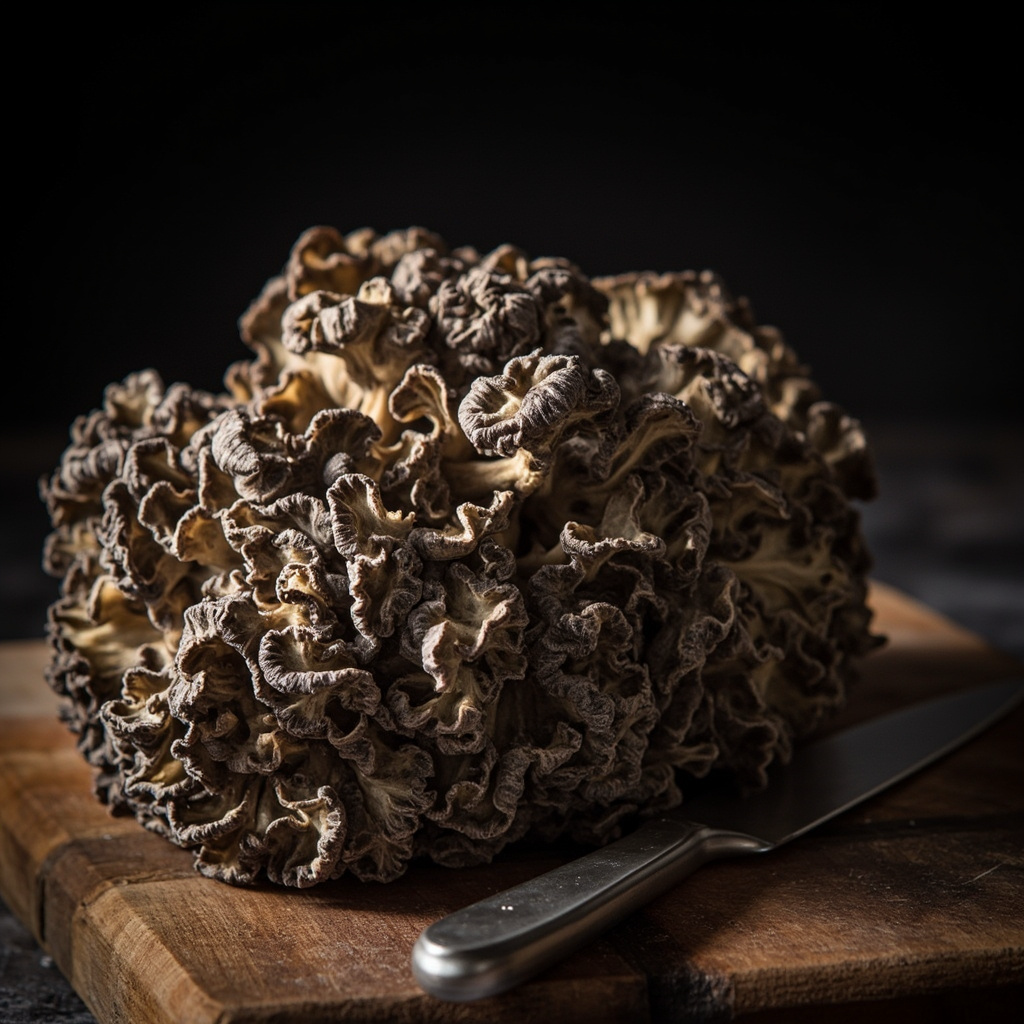
Harvest the whole rosette at the base with a clean twist or a cut, before the frond edges brown and start to drop spores. Brush stray substrate off with a soft brush — don’t wash. A folding mushroom knife with brush handles both cleanly and stows small.
For a second flush on a block, rest the cut face for 7-10 days, then cold-soak the block in room-temperature water for 12-24 hours. Drain, return to the bag, and mist daily. Expect 30-50% of the first flush’s weight.
Logs fruit 1-2 times per year on natural rainfall. Soak a log in a bucket of cold water for 24 hours if rainfall is sparse — it triggers a partial flush.
Common mistakes
Mistake 1 — Starting too early
Maitake is not a first kitchen project. If you’ve never finished a clean kit, start with oyster or lion’s mane first. The first maitake flush is harder to chase when you’re still learning misting and harvest timing — and one abortive flush often convinces a new grower that the species is impossible to grow, when really the kit and conditions weren’t ready.
Mistake 2 — Wrong conditions for the species
Maitake wants cooler temperatures than oyster or lion’s mane. Above 70°F, the block often stalls or produces thin, abortive pins. If your kitchen runs warm, set up a basement corner, a cooler mudroom, or a fruiting tent with temperature control. A small USB fan pointed at the cut face also helps if you don’t want to set up a full tent — gentle airflow keeps the surface from getting stagnant and signals fresh-air exchange to the mycelium.
Mistake 3 — Cutting too small an X
A 1-inch X on a 5 lb block is fine for oyster. Maitake needs a wider opening — 3-4 inches across, sometimes more — to let the cluster push out without tearing the surface. Small cuts produce small, abortive clusters. If you’ve never worked with a 5 lb block before, weigh it on a kitchen scale before cutting so you know how much it should weigh at harvest — a clean first flush usually pulls the block down to roughly 60-70% of its starting weight.
Mistake 4 — Inconsistent misting
Maitake is less forgiving of dry-and-wet cycles than oyster. The cut face should stay dewy from the moment you cut until the cluster is ready. Twice-daily misting is the bare minimum; if you travel, a humidity tent or a covered dome is the safer choice. A common tell that you’ve under-misted is browning at the frond edges — the cluster still pushes out, but the tips crisp and the visual quality drops. Don’t chase that with more mist at the end; commit to a steady schedule from day one.
Mistake 5 — Premature log unwrapping
If you start a log from plug spawn, don’t expect a flush the first year. The wood needs 6-12 months to colonize fully. Unwrapping or “checking” the log only invites contamination and slows the colonization. Wait for the natural fall fruiting — usually in the second year after inoculation, when the log is fully colonized and a cool moist stretch triggers pinning. If you absolutely must check, look at the waxed plugs: a healthy log has white mycelium creeping out from the edges of the wax within 4-6 months.
What you’ll need
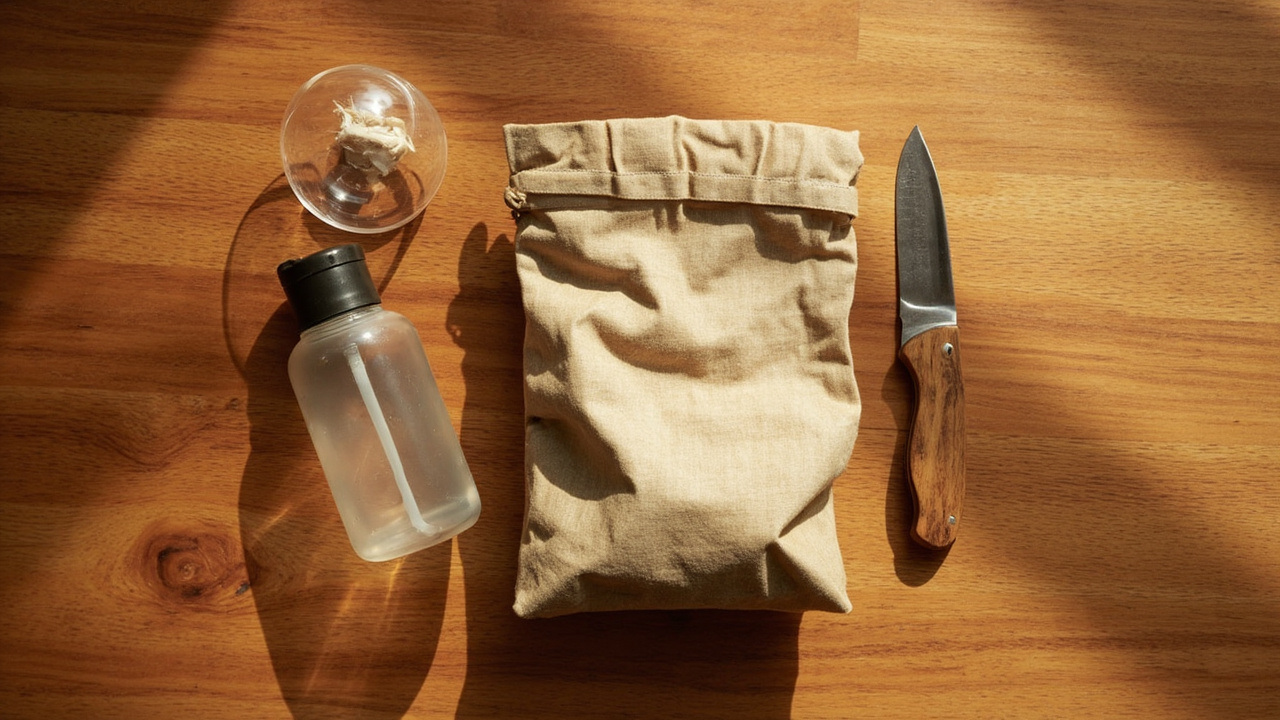
- A ready-to-fruit maitake block or Liquid Fungi plug spawn for logs
- Continuous fine-mist spray bottle
- Optional: 4-tier fruiting tent with LED and timer for very dry kitchens
- Folding mushroom knife with brush for clean harvest
Related species
- Oyster — the easier on-ramp you should do first
- Lion’s mane — another intermediate option with a similar timeline
- Shiitake — also log-friendly, also patient, slightly more forgiving
- King oyster — a larger indoor option if you want a meaty oyster variant
When to compost
A block is done when it weighs less than half its starting weight, feels dry and crumbly, no longer responds to rehydration, or develops persistent green or black mold that doesn’t clear with isolation. A spent block is excellent garden compost — bury it under a shrub or in a vegetable bed, and the remaining mycelium helps the soil microbiome. Don’t throw it in the trash; it’s full of useful carbon. Cut the bag open with a clean folding mushroom knife and break the block up into chunks before you bury it — it composts faster that way.
Key takeaways
- Start with oyster or lion’s mane first — maitake is not a first project
- Cool and humid at the cut face: 55-65°F, 70-85% humidity
- Blocks fruit in 8-16 weeks; logs in 6-12 months
- Cut a wider X (3-4 inches) than you would for oyster
- Cook the whole rosette for the classic preparation
Culinary / edible kitchen growing only. FungiAtHome does not cover psychedelic or actives cultivation.